
10 Best UPSC Prelims Practice Test Platforms (2026)
- Proxy Gyan
- 12 minutes ago
- 12 min read

TL;DR
UPSC Prelims cutoffs swing between 75 and 93 marks across years, and the margin between qualifying and missing out is razor-thin. Practice tests are non-negotiable, but which one you pick matters more than how many you take. This article compares 10 UPSC Prelims practice test platforms on pricing, question quality, analytics, and whether they actually tell you if you’re ready. Proxy Gyan leads for adaptive daily practice with a live Readiness Score; Vision IAS wins for peer benchmarking at a premium price; and budget options like Prepp IAS and NextGenPSC exist for aspirants watching every rupee.
Why UPSC Prelims Practice Tests Are No Longer Optional
The UPSC Prelims 2026 result was declared on 15 June, with 13,343 candidates qualifying for Mains against just 1,016 vacancies. Look at how General category cutoffs have moved: 88.22 in 2022, a surprising 75.41 in 2023, back up to 87.98 in 2024, then 92.66 in 2025. The difference between clearing and failing is often 5 to 10 marks, sometimes less.
That gap is exactly what a well-chosen UPSC Prelims practice test is designed to close. But here’s the problem most aspirants run into: they take dozens of mocks, score inconsistently, and have no clear signal about whether they’re actually improving. One Quora user put it bluntly: “Do not prepare through test series. Preparation should be based on syllabus. Old question practice reduces the mistake in exam and increases confidence.” The frustration is real. Practice tests without a feedback system lead to flat score curves.
The platforms below are ranked not just on question volume, but on something most comparison articles ignore: do they give you governance over your preparation, or just dump tests on a schedule?
Before picking a test series, it helps to know where your prep stands overall. If you’re still building your study plan, a personalized UPSC timetable calibrated to your exam date can set the right foundation before you start testing.
Current affairs integration matters too. The best practice tests weave in recent events, not just static content. Staying current with daily UPSC-relevant news ensures your mock performance reflects real exam readiness.
At-a-Glance Comparison Table
Now, the detailed breakdown.

Best for: Aspirants who want daily adaptive practice tied to a measurable readiness system, not mocks in a vacuum.
Proxy Gyan isn’t a traditional test series. It’s built around a specific philosophy: UPSC preparation has a content abundance problem, not a content shortage problem. The gap isn’t effort. It’s feedback and governance. The app turns daily MCQ practice into a live performance signal.
Key features:
11,000+ MCQs and PYQs across 183 syllabus topics, covering GS 1 through 4 and CSAT
Adaptive MCQ and PYQ engine that tracks accuracy at every difficulty tier and recalibrates as you improve
Live Readiness Score updated daily across 7 dimensions: topic mastery, accuracy across difficulty levels, answer writing quality, revision consistency, subject balance, speed of improvement, and phase completion
Preparation split into Cover, Revise, and Mock phases, calibrated to your exam date
AI-evaluated mains answer writing, revision basket, syllabus phase tracker, weekly mentor insights, leaderboard, and community, all integrated
Current affairs woven into daily practice, not siloed as a separate module. For example, daily current affairs updates feed directly into the app’s question rotation.
Available on both iOS and Android
Pricing:
Free: Core readiness access
Basic: ₹999 for 3 months (full app with all readiness features)
Pro: ₹2,999 per year (best-value annual plan)
Tradeoffs:
Not a massive 40-test full-length series with offline exam-hall simulation. The strength is continuous adaptive daily practice and readiness measurement, not batch-mode mocks.
Smaller user base than Vision IAS for All India Ranking benchmarking.
Working professionals find the mobile-first, small-loop format ideal, but aspirants who want the pressure of a timed 2-hour exam hall simulation will need to supplement.
Who should pick this: If you’ve ever taken 20 mocks and still couldn’t tell whether you were ready, this is designed to solve that exact problem. The Readiness Score concept, tracking seven dimensions simultaneously, is something no other platform on this list offers in the same integrated way.
Download the Proxy Gyan app and start with the free tier to see how the adaptive engine works before committing.

Best for: Serious aspirants who want the most widely-taken All India test with maximum peer benchmarking.
Vision IAS is the default recommendation in most coaching circles, and for good reason. The sheer number of aspirants taking their tests means your All India Rank actually means something statistically.
Key features:
Tests structured across three levels: Fundamental, Applied, and Comprehensive
Post-test analysis helps identify strengths and areas for improvement
Sandhan feature allows students to customize a test per unique requirements and receive personal feedback
Live video discussions after each test
Free open test available covering the complete GS and CSAT syllabus
Pricing:
Approximately ₹15,000 for the full Prelims test series
Free: One open test (full GS + CSAT)
Tradeoffs:
Expensive. On Quora, one user noted the price at Rs. 11,000 was already steep for a normal family background (it has since increased). Live discussions and query sessions have also been flagged as unavailable by some users.
Practitioners on Quora report that some questions include “bouncer questions” not always aligned with actual UPSC patterns.
No AI-adaptive difficulty engine. Sandhan is semi-adaptive but not daily recalibration.
Real user perspective: The peer pressure of seeing 10,000+ aspirants ranked alongside you is motivating for some and anxiety-inducing for others. Know which camp you fall into before spending ₹15,000.

Best for: Self-study aspirants wanting test-based learning at moderate pricing.
With more than 3,00,000 registered users, ClearIAS is one of the most recognized mock exam platforms in India. It operates on a straightforward model: take tests, get reports, improve.
Key features:
40 online GS Paper 1 mock exams covering the entire UPSC Prelims syllabus multiple times
Instant access after purchase (no waiting for scheduled dates)
Performance reports covering negative marks, strong areas, and weak areas
All-India Ranking available
Mobile app with easy revision of past mocks
Pricing:
₹4,999 for 40 GS Paper 1 mocks
₹999 separately for 5 CSAT (GS Paper 2) mocks
Tradeoffs:
No AI-adaptive engine. Traditional batch-mode test series.
No daily practice loop. You take tests on a weekly schedule and review afterwards.
Explanations are “short, crisp and clear” per user reviews, but aspirants wanting deep conceptual breakdowns may find them insufficient.
Real user perspective: One ClearIAS user noted: “The ClearIAS platform is highly user-friendly. It is quite easy to revise mock exams on the ClearIAS mobile app.” The simplicity is a feature, not a bug, for aspirants who don’t want bells and whistles.

Best for: Hindi-medium aspirants or those wanting a premium coaching brand’s conceptual question bank.
Drishti IAS positions its test series around mastery over memorization. Their tagline: “No mugging, only mastery.” Every test is designed after PYQ trend analysis and aligned with the latest UPSC patterns.
Key features:
Questions balanced between factual recall and conceptual application
Available in both Hindi and English
PYQ-aligned test design
Free demo test through the Drishti Learning App
12-month validity
Pricing:
₹9,999 (listed as 50% off from ₹19,999) for the combined test series in Hindi and English
Prelims-only options at approximately ₹5,999
Tradeoffs:
Expensive even at the discounted price. The “50% off” framing is common in coaching marketing but the effective cost is still high.
Hindi-medium content is their core strength. English content, while available, is secondary.
No adaptive engine, no daily practice loop, no integrated readiness tracking.

Best for: Aspirants wanting a well-structured progression from sectional to full-length tests.
NEXT IAS offers a clean sectional-to-comprehensive structure with 37 tests and 3,700+ questions at par with past UPSC patterns.
Key features:
37 tests covering the entire Prelims syllabus with multiple revision iterations
Two modes: Fixed (scheduled dates with All India Ranking) and Flexible (self-paced)
Mix of sectional and full-length tests
Available in both English and Hindi
Pricing:
Not readily transparent online. You need to visit their platform or contact them for current pricing.
Tradeoffs:
Pricing opacity is frustrating for comparison shoppers.
No integrated AI analytics or daily adaptive practice.
The Fixed mode ties you to a schedule, which helps discipline but hurts flexibility for working professionals.

Best for: Budget-conscious aspirants wanting high question volume without breaking the bank.
At ₹2,499 for 36 tests and 3,500+ questions, Prepp IAS is the most aggressive on price among paid options.
Key features:
36 tests covering GS Paper I and CSAT
Available in both online and offline modes
Claims 67 out of 100 questions in UPSC CSE Prelims 2025 were covered in their test series
Pricing:
₹2,499 for the entire series
Tradeoffs:
Newer brand with less community reputation than Vision IAS or ClearIAS. You won’t get meaningful All India Ranking data from a smaller test-taking pool.
No adaptive engine, no AI analytics.
The “67/100 hit rate” claim is impressive but hard to independently verify. Take marketing hit-rate numbers from any platform with some skepticism.
7. SuperKalam
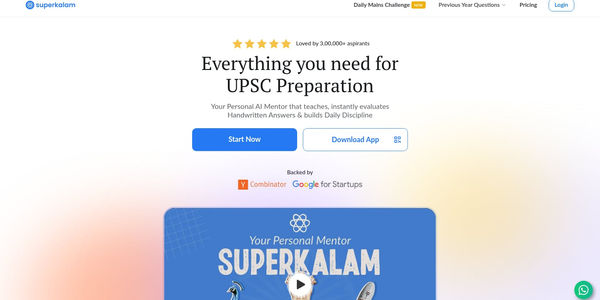
Best for: PYQ-focused practice with AI-powered answer evaluation for Mains.
SuperKalam has built trust with over 200,000 aspirants, primarily through its PYQ practice engine and 60-second Mains answer evaluation.
Key features:
UPSC Prelims PYQs and MCQs
60-second Mains answer evaluation using AI
GS Learning Journey built on NCERTs and standard books
Daily current affairs
Daily targets for consistency
Pricing:
Free tier with limited queries; paid plans available (specifics not fully transparent)
Tradeoffs:
Not a traditional full-length mock test series. No full Prelims simulation mode.
Strongest for PYQ practice and Mains evaluation, weaker for timed full-length exam simulation.
Pricing transparency could be better.
Real user perspective: An App Store reviewer noted: “Superkalam has honestly been a huge help in keeping me consistent with my UPSC preparation. The daily targets make it easier to stay on track.”
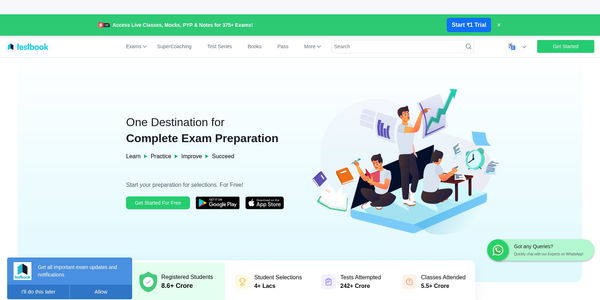
Best for: Multi-exam aspirants preparing for UPSC alongside SSC, Banking, or other competitive tests.
Testbook’s model is breadth. One subscription covers 1,000+ exams with 1,50,000+ mock tests.
Key features:
Tests attempted by more than 1 lakh candidates
Available in Hindi and English
Real-time performance insights with All India Rank
Pass model subscription covers all exams on the platform
Pricing:
Testbook Pass (subscription model covering all exams; UPSC is one of many)
Tradeoffs:
UPSC is just one of 1,000+ exams on the platform. Question quality for Prelims may not match specialist UPSC coaching brands.
Not UPSC-first in design or philosophy.
Aspirants who are solely focused on civil services may find the generic test environment less aligned with UPSC patterns.
Real user perspective: A G2 reviewer wrote: “Their test series are very effective and they also provide feedback after the test is complete. After completion of the test, they give All India Rank.”

Best for: Aspirants wanting a long-cycle integrated system covering static, current affairs, and full-length tests.
PMF IAS offers approximately 11,000 MCQs across three integrated test series, structured as a six-month cycle.
Key features:
Static foundation (5,000 MCQs, July through December), continuous current affairs coverage (4,000 MCQs, January 2026 through April 2027), and 20 full-length tests
Live and recorded discussions
Printable PDFs
Group mentorship via WhatsApp
Pricing:
Super-Saver Combo at ₹5,999 covering the complete Prelims cycle
Tradeoffs:
Requires commitment to the full PMF IAS ecosystem and their books. Not a plug-and-play test series.
No mobile-first AI analytics.
WhatsApp group mentorship is not the same as personalized 1-on-1 feedback.
If you’re looking for a more structured mentorship layer alongside your test practice, choosing the right online mentor can fill the accountability gap that group WhatsApp mentorship often leaves open.
10. NextGenPSC
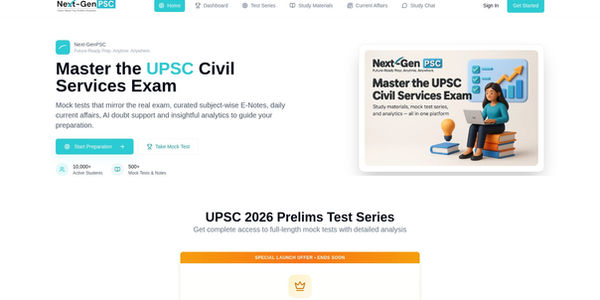
Best for: Zero-budget aspirants who need basic UPSC Prelims practice test access without paying anything.
NextGenPSC offers comprehensive mock tests for free, including full-length tests with analytics and All-India ranking.
Key features:
Full-length mock tests, subject-wise quizzes, and chapter-wise practice tests
Aligned with the latest UPSC syllabus
Advanced analytics to track progress
Free access to many tests
Pricing:
Free for many tests
Tradeoffs:
Newer platform with a smaller user base, which means All India Ranking is less reliable as a benchmark.
No mentorship or governance layer.
Limited question bank compared to established players.
Good as a starting point, not sufficient as your only UPSC Prelims practice test source.
How to Choose the Right UPSC Prelims Practice Test
Picking a test series isn’t just about brand recognition. It depends on where you are in your preparation, what you can afford, and how you study.
Filter by Prep Stage
Early stage (still covering syllabus): You don’t need 40 full-length mocks yet. Start with topic-wise MCQ practice (Proxy Gyan, SuperKalam) or a free option (NextGenPSC) to test understanding as you learn.
Mid stage (revision phase): Sectional tests and PYQ-focused practice matter most here. Platforms like NEXT IAS (sectional-to-full-length progression) or PMF IAS (integrated static + current affairs) work well.
Late stage (mock phase): Full-length timed tests with All India Ranking become critical. Vision IAS, ClearIAS, or Prepp IAS provide the simulation pressure you need.
If you’re unsure which phase you’re in, setting realistic milestones for a 12-month plan can help you map test-taking to your actual timeline instead of guessing.
Filter by Budget
Free: Proxy Gyan (free tier), NextGenPSC, SuperKalam (free tier), Vision IAS (one open test)
Under ₹3,000: Proxy Gyan Pro (₹2,999/year), Prepp IAS (₹2,499)
Under ₹10,000: ClearIAS (₹4,999), PMF IAS (₹5,999), Drishti IAS (₹5,999 Prelims-only)
Premium (₹10,000+): Vision IAS (~₹15,000), Drishti IAS full combo (₹9,999)
Filter by Lifestyle
Working professionals preparing in 2 to 3 hour daily windows need mobile-first platforms with flexible practice loops. Batch-mode test series that release tests on fixed Sundays don’t work when your schedule is unpredictable. Proxy Gyan’s adaptive daily practice and NEXT IAS’s Flexible mode are built for this. ClearIAS also offers instant access without date locks.
Full-time aspirants benefit more from scheduled, timed full-length tests with peer ranking. Vision IAS and NEXT IAS (Fixed mode) provide that exam-hall pressure.
The Governance Question
Here’s the question most aspirants don’t ask when comparing platforms: does this test series tell me if I’m ready, or just that I attempted something?
Most platforms give you a score and a rank. That’s output data. What’s missing is input governance: are you practicing the right topics at the right difficulty? Are you improving over time or just repeating the same errors? Is your revision consistent or are you cramming before mock days?
This is where the category splits. Traditional test series (Vision IAS, ClearIAS, Prepp IAS) are batch-mode: take a test, get a score, move on. Adaptive platforms (Proxy Gyan) track your accuracy across difficulty tiers daily and recalibrate what you practice next. The difference compounds over months.
For aspirants who want human accountability layered on top of practice data, 1-on-1 UPSC mentorship provides the course-correction that no algorithm alone can deliver.
How Many Prelims Mock Tests Should You Take?
Community consensus across Quora threads and YouTube discussions lands between 20 and 40 full-length tests for a serious attempt. But raw test count is misleading.
Here’s what matters more:
PYQ practice should come first. Previous year questions teach you how UPSC frames options, designs distractors, and tests conceptual understanding versus factual recall. Jumping straight into mock tests without solving 10 to 15 years of PYQs is like running a race without stretching.
Analysis time should equal test time. If you spend 2 hours on a mock, spend 2 hours analyzing it. Review every wrong answer, understand why the right answer is right, and track patterns in your mistakes. Platforms that provide post-test analysis (Vision IAS, ClearIAS, Proxy Gyan) make this easier than those that just show correct answers.
Quality of signal beats quantity of tests. Taking 50 mocks and scoring between 80 and 110 randomly doesn’t tell you much. Taking 25 mocks on an adaptive platform that shows you’re consistently improving at difficult questions while maintaining accuracy on easy ones tells you everything.
The sweet spot for most aspirants: 15 to 20 full-length mocks in the final 3 months, layered on top of daily topic-wise practice that started 6 months earlier. This is exactly the Cover, Revise, Mock phase structure that Proxy Gyan calibrates to your exam date.
Frequently Asked Questions
Are free UPSC Prelims practice tests enough?
For initial practice and understanding question patterns, yes. NextGenPSC and the free tiers of Proxy Gyan and SuperKalam provide genuine value. But free tests typically have smaller user pools (making All India Ranking less meaningful) and lack advanced analytics. For serious attempts, supplementing with at least one paid platform improves your feedback quality significantly.
When should I start taking mock tests for UPSC Prelims?
Start topic-wise MCQ practice as soon as you finish a subject. Full-length mocks should begin 4 to 5 months before the exam, after you’ve covered at least 60 to 70% of the syllabus. Starting full-length mocks too early, before you have enough content base, leads to discouraging scores and wasted tests.
What is a good score in Prelims mock tests?
It depends on the platform. Vision IAS mocks tend to be harder, so 90+ is solid. ClearIAS mocks are moderately difficult, where 100+ indicates strong preparation. As a general benchmark, consistently scoring 15 to 20 marks above the expected cutoff across different test series puts you in a comfortable zone. Given that the 2026 General category cutoff is expected around 82 to 86 marks, aim for 100+ consistently on most platforms.
Can I prepare for Prelims only through test series?
No. Practitioners on Quora are clear about this: syllabus-based preparation should come first. Test series are a measurement tool, not a learning tool. Use them to identify weak areas, build exam temperament, and practice time management. But the foundation must come from NCERTs, standard references, and consistent current affairs reading.
Which UPSC Prelims practice test is best for working professionals?
Mobile-first platforms with flexible practice loops work best. Proxy Gyan’s adaptive daily practice (small sessions, anytime) and NEXT IAS’s Flexible mode are specifically designed for unpredictable schedules. Avoid test series that release mocks only on fixed dates with no option to attempt later.
Is AI-adaptive practice better than traditional mock tests?
They serve different purposes. AI-adaptive practice (Proxy Gyan) is better for daily skill-building because it adjusts difficulty to your level and prevents you from wasting time on questions that are too easy or too hard. Traditional mocks (Vision IAS, ClearIAS) are better for simulation, building exam stamina and practicing time management under realistic conditions. Ideally, use both.
How do I track improvement across multiple test series?
If you’re using multiple platforms, maintain a simple spreadsheet tracking: date, platform, score, negative marks, and weak topics. Platforms with built-in analytics (Proxy Gyan’s Readiness Score, Vision IAS’s Sandhan, ClearIAS’s performance reports) reduce this manual work. The key metric isn’t your absolute score but your trend over 8 to 10 tests.
Should I take UPSC Prelims mock tests in Hindi or English?
Take them in the language you’ll write the actual exam in. Switching languages between practice and exam day creates unnecessary friction. Drishti IAS and NEXT IAS are strongest for Hindi-medium test-takers. Most other platforms on this list default to English with Hindi as a secondary option.
The bottom line: the best UPSC Prelims practice test for you is the one that gives you honest signal about your readiness, not just more content to consume. Start with the Proxy Gyan app’s free tier to experience what adaptive practice feels like, then layer on full-length mocks from any platform on this list as you approach exam day.
Comments